
Because the WW2 Museum Degenerative Art exhibit only runs through May 10, I wanted to tell you about it right away! Thanks so Keith Darcy, Senior Director of Communications, Steve and I were able to attend. It was so informative and sadly haunting, that I had to interrupt my actual timeline of events to tell you all about it. If you are planning a trip to New Orleans before it closes, make sure to attend. And if you need an excuse to visit my beloved NOLA, this is a great one.

Entering the Degenerate Art Exhibit

Caricature by George Grosz, German, 1893-1959

The Artist in the Company, 1922 by Max Beckman, Drypoint etching
The National World War 2 Museum in New Orleans is one of those places that draws us back year after year. There’s always something new to experience. And attending events there makes us feel part of the community.

Panel discussion with Christoper C. Gorham (seated left), author of Matisse at War

100 year old WW2 veteran rings the bell on Pearl Harbor Day December 7, 2026

The Sacrifice, plate 1 from Krieg (War), 1922, published in 1923 by Käthe Kollwitz, Woodcut.
When we first arrived we enjoyed an evening with Christopher C. Gorham, author of Matisse at War. There was a wonderful discussion about art and resistance in Nazi occupied France. Ot was a great lead in to the exhibition Degenerate! Hitler’s War on Modern Art.

I Have Done My Part, from The Robber, 1922 by George Grosz

The War, 1924 by Otto Dix. Lithograph (book cover art)

Farmer’s Children-Two Children With A Hare, 1923 by Fritz Burmann
A few days later we attended the very moving Pearl Harbor Day Commemorative Ceremony. The highlight of that was honor of seeing 100 year old WW2 veteran ring the bell to recognize those who lost their lives that day.

The Blind Man, 1925 by Franz Maria Jansen

Woman with Babushka, 1927 by Ernst Fritsch. Oil on canvas.

Shoemaker’s Son, 1922 by Ernst Fitsch. Oil on canvas
And Steve and I returned in January for the WW2 Museum Degenerative Art exhibition. “Blending art, music, and history, the exhibit explores how modernist works were weaponized as tools of Nazi propaganda and public indoctrination, and how artists and musicians responded to the escalating suppression. See original works by modern masters like Picasso, Kandinsky, Matisse, and Chagall, and hear stories of those who continued to create as an act of resistance.” “This exhibit was originally created by and on loan from the Jewish Museum Milwaukee, Degenerate! Hitler’s War on Modern Art is made possible at The National WWII Museum through the generous support of the Collins C. Diboll Foundation, with additional support from the Jewish Endowment Foundation of Louisiana.”

In the Street, 1914 by Hugó Scheiber. Gauche, color crayon

Siblings1913 by Erich Heckel. Woodcut

No Title (Yellow, Red, Black, White Abstract Boat), 1915 by Wassily Kandinsky. Monograph
In 1937 a Degenerate Art exhibition was held. It was primarily designed as a smear tactic to ridicule modernism. However it became one of the most popular art shows of the 20th century. Over 2 million visitors came to see the works, proving that the public had a true fascination with the art the Nazis sought to condemn.

Joyous Ascent, 1923 by Wassily Kandinsky. Color lithograph.

Totalitarianism! Propagandizing Culture

Chichikov Arrives at the Ball, from Dead Souls, 1923/27, published 1948 by Marc Chagall. Etching and drypoint.
Following the exhibition, over 23,000 works of art were confiscated from state collections. Some of them were destroyed, others were sold on the international market to support the Third Reich and many were taken into the private collections of Nazi leaders. Those artists who were targeted lost their teaching positions and were banned from exhibiting. Many fled abroad and carried their modernist ideas across Europe and the USA. This influx of talented artists helped establish New York as the new center of avant-garde art after the war.

The Pinch of Snuff, 1922-23 by Marc Chagall. Watercolor on cardboard

The City Officials Meet, plate 70 from Dead Souls, by Marc Chagall. Etching and drypoint.

Lost Way, ca. 1922 by Karl Volker. Ink on paper.
Racial ideology shaped ever aspect of cultural life in Nazi Germany. Music, just like visual art, was tightly monitored. A 1938 Degenerative Music exhibition took place. The catalogue for the event stated that “degenerate art and degenerate music hand in hand. With a goal of underscoring their shared mission, the show was designed to vilify works that were linked to Jewish creators, foreign influences and modernized experimentation.

Paranoid, ca. 1930 by Bruno Voigt. Watercolor and ink.

Cemetery, 1921 by Pol Cassel. Oil on canvas

The Prophet, 1937 by Ludwig Meidner. Oil
The show’s curator, Hans Ziegler, stated that it was aimed at exposing what was “diseased, unhealthy and highly dangerous” in German music. “An effigy of wickedness – an effigy of arrogant Jewish impudence and complete spiritual insipidness” is what he railed in his opening speech.
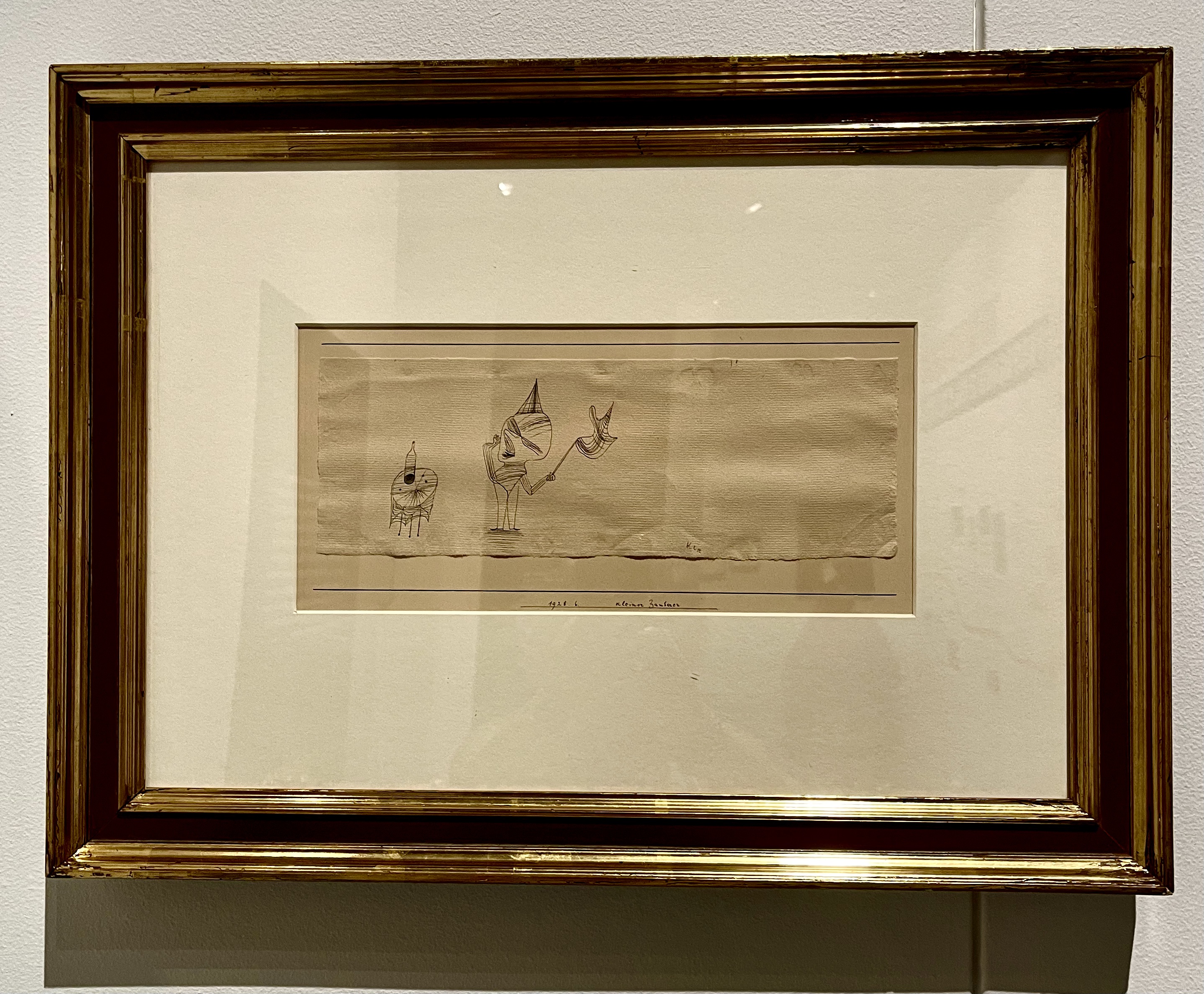
The Little Sorcerer, 1928 by Paul Klee. Ink drawing.

Lissy, 1931 by Elfriede Lohse-Wächtler. Watercolor

Seated Woman with Flowers, ca. 1920-21 by Martel Schwichtenberg. Oil on canvas.
Hitler’s campaign against degenerate art and music revealed just how easily the arts can be shaped and suppressed by those in power. Not only does this dark chapter in history point out how quickly fear can erode the space for expression, experimentation and dissent, but it can mobilize the arts as well. It also testifies to the resilience of creativity and just how important it is to protect a diverse and uncensored cultural landscape. These freedoms were central to World War II and are just as vital, if not more so, today.

Girl with Blue Eyes and Green Dress, 1916 by Alexej von Jawlensky. Oil on board.

Mural by Wassily Kandinsky

Dada Art by George Grof
Under Adolf Hitler’s reign of terror, artistic movements were condemned as being degenerate. Entire movements at the heart of European modernism were labeled as degenerate!

Backyard, 1931 by Gerta Overbeck-Schenk. Oil on canvas.

At the Easel, 1922-23 by Marc Chagall. Etching and drypoint.

Saxophone represents music, especially Jazz, being deemed Degenerate!
As Americans we have taken for granted our inalienable right to freedom of expression. This powerful exhibit made me realize just how fragile our rights are. And how we must all fight to ensure nothing stands in our way of keeping our rights and freedoms alive!!!

“And Then They Came For Me,,,”







Trackbacks/Pingbacks